University of Debrecen Archívum | Diplomátszerzek

Komondor supercomputer handed over at the University of Debrecen

The five petaflops system cost 4.7 billion forints and took two years to build. Komondor will increase the country’s current HPC (High Performance Computing) capacity tenfold.

The country’s newest and most powerful supercomputer is needed to process large amounts of data in almost all scientific fields. Komondor, which includes artificial intelligence and big data partitions, can perform up to 10,000 times the computing and data processing power of desktop machines per second. It has the capacity to run fifty thousand laptops simultaneously.
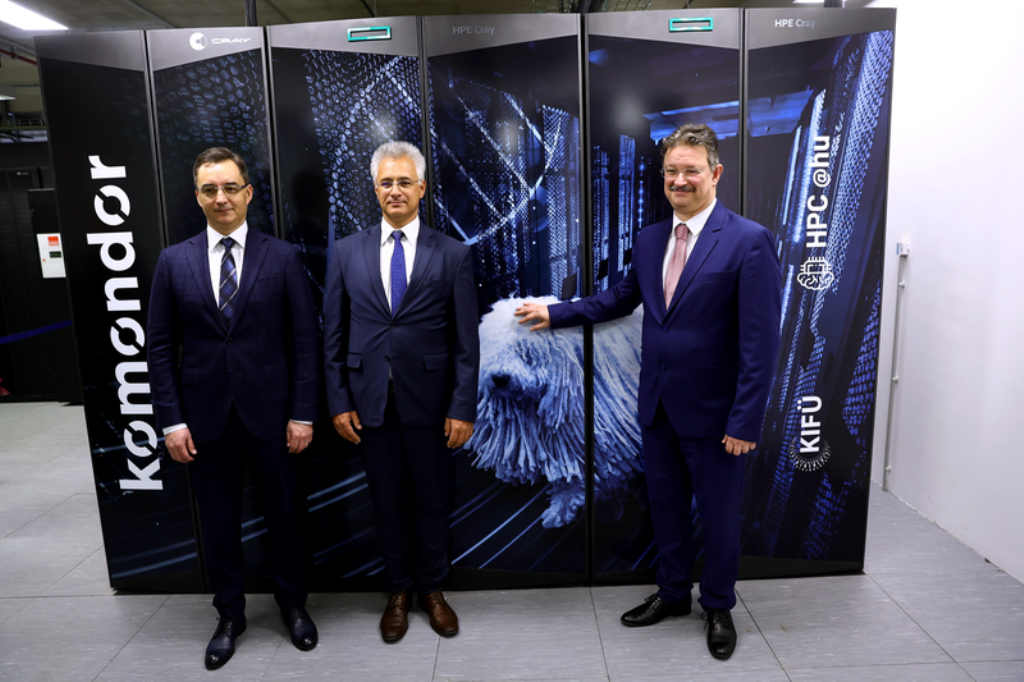
Zoltán Bács, chancellor of the University of Debrecen (on the right) and Endre Spaller, president of KIFÜ (in the middle) at the handover ceremony. (Photo: MTI)

The supercomputer will also support the future work of the teaching and research staff of the University of Debrecen.

Speaking at the handover ceremony, Endre Spaller, president of KIFÜ, said, „Komondor is a research infrastructure that will primarily be used by researchers, but it can also strengthen high value-added activities in the economy”.

We wrote in November 2022 about the University of Debrecen that Hungary’s largest e-sports centre, mainly for educational purposes, has been inaugurated. The University of Debrecen’s facility will not only serve e-sports players, but also support the university’s IT and technical trainings.


 

Hungary’s largest e-sports centre, mainly for educational purposes, has been inaugurated

The 330-square-metre, 300 million HUF investment – partly financed by the government and partly by the university itself – has made the centre the largest e-sports facility in the country, specifically for educational purposes, and it can be used by up to 100 people at a time.

Zoltán Bács, chancellor of the university, said at the inauguration ceremony of the facility built in the Nagyerdei Stadium that the e-sports centre is primarily for educational purposes, as it supports the training of the faculties of computer science, economics and engineering, and can also be used by DEAC and DVSC e-sports players.

The University of Debrecen is considered one of the strongholds of Hungarian e-sports, both because of its e-sports department, the DEAC-Hackers, and because of its scientific research in the field of e-sports, the University of Debrecen said in a press release.

E-sports can make computer sciences attractive

Balázs Hankó, Deputy State Secretary for Higher Education, said that there is a growing need for young people to obtain a degree in technical and IT fields. „Among them, online games and e-sports are becoming increasingly popular. We are taking advantage of their popularity to attract young people, who can then go on to higher education to learn about IT and engineering,” he said.

Marianna Kovács, Managing Director of the Debrecen University Athletics Club; Zoltán Bács, Chancellor of the University of Debrecen; Balázs Hankó, Deputy State Secretary for Higher Education and András Hajdu, Dean of the Faculty of IT (from left to right) at the inauguration of the E-Sports Centre (Photo: MTI/Vajda János)

Balázs Hankó pointed out that

[kiemelt]the number of people who are in some way connected with e-sports-related games is estimated at four million, and 640,000 people play e-sports regularly.[/kiemelt]

„They could be the IT and technical specialists of the future,” he added. He also stressed that 7425 IT students were admitted to universities in the country this year.

András Hajdu, dean of the IT faculty, pointed out that because the graphics cards of the machines in the facility are very powerful, these computers can also handle educational tasks that require a lot of computing power. He gave as examples artificial intelligence-based models, computer graphics and virtual reality.

We recently reported that the Hungarian team won three bronze medals at the European Girls’ Olympiad in Informatics (EGOI), a competition designed to encourage more women to choose a career in the ICT sector.

The number of foreign students is getting increasing in Hungary

For the first time, the University of Miskolc (UM) organised a freshmen’s camp for international students. The three-day programme was attended by nearly 100 newly admitted international students from countries all over the world (e.g. Pakistan, India, Spain, France).

According to Quacquarelli Symonds (QS), a London-based analytical firm that rates the performance of universities, the number of international students at UM is about 450, representing 5.6 per cent of the institution’s total student community of nearly 8,000.

Semmelweis University has the highest proportion of foreign students

In Hungary, Semmelweis University has the highest proportion of foreign students. According to the data available on the university’s website, the proportion of international students in the second semester of the academic year 2021-2022 was nearly 35 per cent, with almost 4,000 international students.

In the academic year 2022/2023 more students than ever before have started their studies in English and German at the university which is celebrating the 40th anniversary of its international medical training.

Photo: pexels.com

Debrecen has the largest international student community

While Semmelweis University has the highest proportion of foreign students in Hungary, the University of Debrecen has the largest international student community in terms of numbers. In the academic year 2022/23, nearly 7,200 international students are studying at the university, which, according to the institution’s website, is more than a fifth of the international students studying in Hungary and the largest foreign student group in Central and Eastern Europe.

At the University of Szeged, which also hosts a large international student community, has nearly 5,000 foreign students in the academic year just started.

Number of foreign students has doubled in ten years

The number of foreign students studying in Hungary has increased significantly in recent years. According to an analysis of KSH (the Hungarian Central Statistical Office) published last summer, between the 2010/2011 and the 2020/2021 academic years, the number of foreign students increased from 15,000 to 32,000, and their rate within all students rose from 6.9 per cent to 17 per cent.

Most foreign students study in the field of health and welfare (32 per cent); besides this, engineering, manufacturing and construction (12 per cent), and social sciences (10 per cent) training courses were the most popular among them in the 2020/2021 academic year.

We recently reported that Budapest was ranked 66th in this year’s QS survey of the world’s best student cities which specifically targets young people considering studying abroad. The Hungarian capital achieved its best result in the indicator of affordability. In this aspect it was ranked 30th in the list of 110 cities, which evaluates a wide range of factors.