In the scope of the research, we conducted a questionnaire survey, which reached our target audience through the UNI website, the Facebook pages of the university’s HÖKs with the help of the HÖOK and the Mateking.hu mailing list. It forms could be filled in between 19 March and 18 April.

All together 1,704 respondents, obviously matching our target group, filled in the questionnaire, which we divided into three major themes. Thus, their responses form the basis of our analysis and the sample can be considered representative. The questionnaire included both closed (multiple-choice, Likert scale) and open questions.
Who completed it? Introduction of the respondents
Nearly 70 percent of the 1,704 completers were female, while in terms of age range, 78 percent of respondents were aged between 18 and 23, 17 percent were aged 27-29, and the remaining 5 percent were aged 30 and over. Most respondents are continuing their studies at BGE (15.7 percent), but there was also strong interest from students at BME (10.1), ELTE (8.2), PTE (7.7), SZE (7.3), DE (6.9) and SZTE (6.3).
As illustrated in Figure 1, most respondents (32.3 percent) started their studies in the academic year 2021/22.
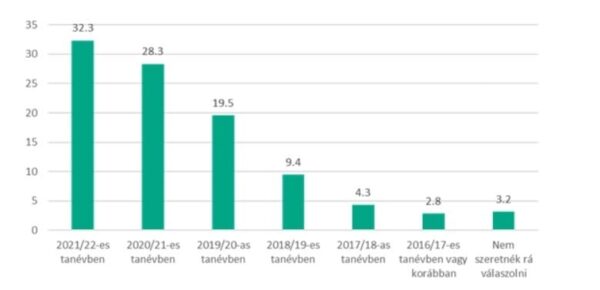
Figure 1. When did you start your university studies? % (n = 1704)
A third of the respondents were studying economics, but the response rate was also high among students in engineering and IT (13.8 per cent for the former and 10.3 per cent for the latter).
Nearly 92% of respondents are studying full-time, 82% with public scholarships. Most respondents are in bachelor’s degree programmes (74.3 per cent), but there were also respondents in undivided master’s degree programmes (10.3 per cent) and master’s degree programmes (7.7 per cent).
Why does a subject or course become a favourite? To learn to learn
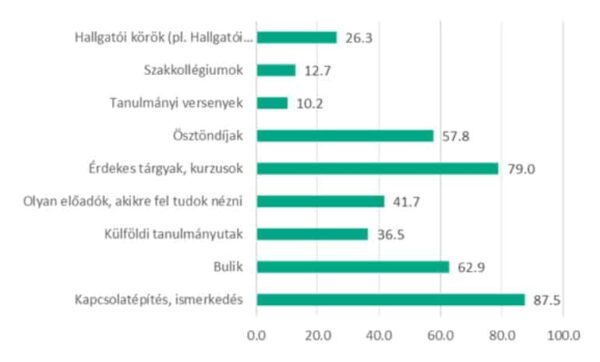
Our questionnaire also asked respondents what they like best about university life (Figure 2). Unsurprisingly, most respondents cited networking and getting to know other people – 87% of respondents think this is one of the greatest benefits of university life. Slightly behind this proportion, but compared to the rest, the opportunity to attend interesting courses and subjects during their university years is also important to many.
Respondents’ favourite subjects cover a very broad spectrum, but it is more interesting to look at why they consider a particular subject to be a favourite than to review these. The analysis of the responses shows that it is the practical orientation of the subjects and courses, as well as the preparedness of the teacher, the instructor and, in many cases, the personality of the teacher, that make a subject or course likeable. Of course, the importance of the students’ interests is also very evident.
Where and how do you prefer to learn? The conditions of learning
With our questionnaire, we also wanted to find out what kind of environment and what kind of methods you prefer to learn in, or how you learn most effectively. The most popular learning environment turned out to be your own room (respondents think this is almost entirely true for them).
This is significantly behind the library or a room on campus specifically designed for learning. The lowest rating was given to the dormitory study room – students even prefer to study in cafés and restaurants (at least according to our data) rather than in dormitory study rooms.
How much do you study per week?
We also looked at how much time fillers usually spend studying and preparing in a week. Most people (28 percent) spend 3-5 hours or 5-10 hours (26 percent) studying or preparing in a week, and about 16-16 percent spend less than 3 hours or 10-15 hours. Again, the proportion of people who study for more than 15 hours a week is the lowest (13 percent). This section also shows how the time spent studying varies by field of study.
What do you want after graduation? Programmes, jobs, career opportunities
Setting career goals is not easy. In the questionnaire, we have included questions to help you outline your ideas for the future. So we also tried to find out how you choose your path and what helps you make that choice.
We asked you what kind of working conditions you would like to have after graduation – this is illustrated in Figure 2. Unsurprisingly, high pay was found to be the most motivating factor – 86 percent of respondents think so. In addition, the quality of the community, how „cool” colleagues are, and whether there are opportunities for career advancement also appear to be of outstanding importance.
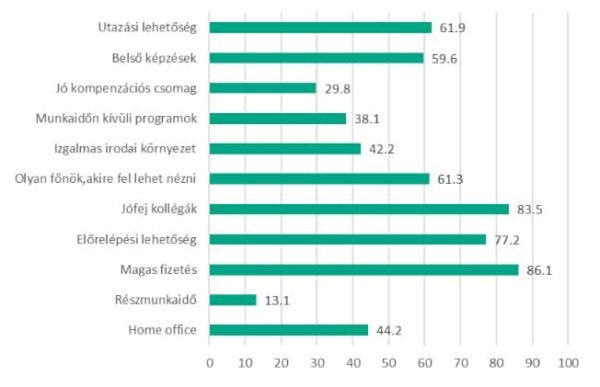
Medium factors include whether the employer provides travel opportunities, whether the boss is someone to look up to and whether internal training is provided. The possibility of part-time work and good compensation packages were less prominent in the responses.
Entrepreneurship as an opportunity!
We also asked respondents to what extent they feel that their studies have given them the skills they need in order to be able start and run a business.
This question was answered by 870 respondents on a five-point scale, with an average of 2.68. However, there is a significant difference when looking at this question by field of study. Students/graduates in economics, law and agriculture are the most likely to feel that they have acquired the skills needed to start and run a business during their studies, while students/graduates in humanities, medicine and health and teacher education are the least likely to think so.
How do you make a decision when you go to university?
In our questionnaire, we also wanted to find out what people choose to study at a higher education institution after secondary school. Young people make this decision mostly on the basis of information about the institution, but they also take into account the location of the university, the expected salary after graduation and their own academic performance.
The advice of friends and teachers has the least influence on this decision. The information they need to make their decision is most often found on university websites, at open days or on the institutions’ social media platforms.
42% of respondents said they found it difficult to prepare for their school-leaving exams. We also asked what they did to pass the exam and gain extra points: most (almost 69%) passed a language test, but there was also a high proportion of respondents who used an online platform to prepare (51%), went to a private tutor (49%) or attended a preparation course at school (42%).


