
The small satellite with a size of 5x5x15 centimetres was built by teachers, researchers and students of the BME Department of Broadband Communications and Electrical Engineering in a three-year joint work. Its name MRC-100 was given in honour of the University Radio Club (Műegyetemi Rádió Club), which will be 100 years old in 2024.
The small satellite will study the electrosmog around the Earth
The new spacecraft, which will study electrosmog around the Earth, has a position stabilisation system in addition to the sub-units ensuring the correct operation and the equipment responsible for testing the electrosmog.
In addition to independent experiments carried out at three other universities—the University of Szeged, the Széchenyi István University in Győr and the University of Debrecen—, the measuring instruments of H-Ion and 27G Ltds will also be sent into space on board of the small satellite – BME said in a press release.
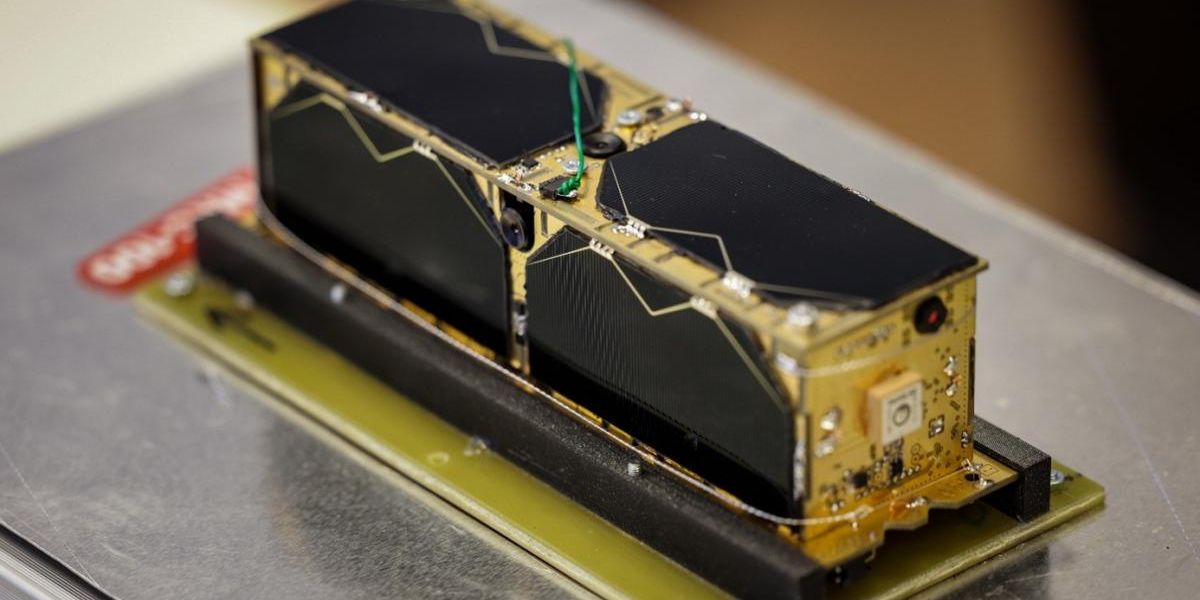
The small satellite with a size of 5x5x15 centimetres was built by teachers, researchers and students of BME in a three-year joint work.(Photo: BME)
The launching costs were covered by the American ARDC (Amateur Radio Digital Communications) foundation. The condition of the grant was that the MRC-100 study the electrosmog around the Earth in a wide frequency range.
The most significant Hungarian supporters of the project were the National Media and Infocommunications Authority and the Ministry of Foreign Affairs and Trade.
Falcon-9 rocket will carry the small satellite into outer space
[kiemelt]The satellite is expected to be launched into outer space in May from the United States by a Falcon-9 rocket developed by SpaceX, the space company of Elon Musk, American business magnate.[/kiemelt]
MTI also reports that the MRC-100 is the fifth and largest satellite in the SMOG series, launched in 2013 and developed at BME. As part of the project, the SMOG-P pocket satellite was launched in December 2019 and completed its mission at the end of September 2020. Based on the measurement results, the first electromagnetic pollution map was created, which showed the electromagnetic effect of digital terrestrial TV broadcasting.
About a month ago, we reported that a rocket development team of engineering candidates from BME has been ranked in the top 10 in Europe’s most prestigious university rocket launch competition.


